
In Kenya’s changing climate, relying solely on rain-fed agriculture is increasingly risky. Across Nakuru, Naivasha, Molo, Subukia, and surrounding Rift Valley counties, erratic rainfall and prolonged dry spells threaten crop yields and farm profitability.
Drip irrigation delivers water directly to plant roots, saving up to 70% more water than traditional furrow or hose-watering methods while applying soluble fertilizers efficiently (fertigation).
Whether you are managing a 1/8-acre kitchen garden or scaling up a commercial 1-acre plot, this step-by-step guide walks you through selecting the right drip system for your budget, estimating costs, and completing a successful installation.
1. Choosing the Right Drip System
Selecting the correct setup depends on your crop choice, field slope, and water source pressure.
A. System Type
-
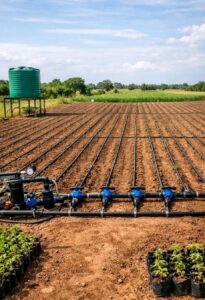
Gravity-Fed Drip Kits (Best for 1/8 – 1/2 Acre): Operates without electricity or fuel pumps. Water feeds from a raised storage tank (elevated 1.5 -3 meters above ground) to create natural flow pressure through 16mm drip lines.
-
Pump-Driven & Solar Boosted Kits: Uses a small petrol, diesel, or solar booster pump to supply water directly from a dam, river, or shallow borehole through a primary filter unit.
-
Pressure-Compensating (PC) Lines: Feature internal silicon diaphragms inside each dripper to ensure every plant receives equal water volume (1.0 – 2.0 L/h), making them ideal for sloped terrain (like hillside farms in Molo or Subukia) and long rows (>100m).
B. Emitter Spacing & Lines per Bed
-
Close Spacing (15cm Emitter Spacing, 3 – 4 Lines/Bed): Onions, garlic, carrots, and high-density herbs.
-
Medium Spacing (20cm – 30cm Spacing, 2 Lines/Bed): Tomatoes, capsicum, cabbages, kale (sukuma wiki), and spinach.
-
Wide Spacing (30cm – 40cm Spacing, 1 Line/Bed): Watermelons, butternut squash, and pumpkins.
2. Estimated Costs for Smallholder Plots in Kenya
The total cost depends primarily on your land size, the number of drip tape lines required per bed, and whether you need storage tanks or booster pumps:
| Farm Size | Drip Kit Price Range (KES)* | Typical Layout | Recommended Crops |
| Kitchen Garden (1/8 Acre) | KES 18,000 – 25,000 | 1-2 lines/bed | Kales, spinach, indigenous greens, herbs |
| 1/4 Acre Plot | KES 38,000 – 50,000 | 2 lines/bed | Tomatoes, capsicum, cabbages, strawberries |
| 1/2 Acre Plot | KES 75,000 – 95,000 | 2-3 lines/bed | Onions, peppers, French beans, passion fruit |
| 1 Full Acre | KES 100,000 – 185,000 | 2-4 lines/bed | Commercial horticulture, tree crops, open-field vegetables |
> Note: Excludes the cost of plastic water tanks or custom-lined timber tank boxes, elevated steel/timber stands, or pump hardware if required.
3. Essential Tools & Materials Checklist
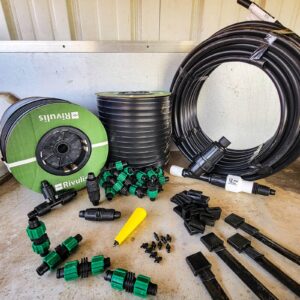
Before starting your installation, gather the following hardware:
Hardware Checklist
-
Tools: Measuring tape (30m), jembe/hoe, tape-cutting shears, 16mm flat drill bit or pipe punch, and Teflon tape.
-
Mainline & Sub-Mains: 8 – 10 HDPE pipes (32mm, 50mm, or 63mm) or uPVC pressure pipes.
-
Filtration Unit: Disc or screen filter (1″ or 1.5″).
-
Connectors & Valves: 16mm rubber grommets, mini ball-valve off-takes, 16mm straight joiners, and Figure-8 end plugs.
-
Drip Line: 16mm UV-stabilized lateral drip tape (0.3mm – 0.4mm wall thickness).
4. Step-by-Step DIY Installation Guide
Step 1: Land & Bed Preparation
-
Form raised crop beds approximately 1 meter wide and 15 – 20cm high.
-
Leave walking paths (40 – 50cm wide) between beds for weeding and harvesting.
-
Rake the tops of the beds until smooth and flat to prevent water from pooling in low spots.
Step 2: Set Up Water Storage & Filtration
-
Mount your water tank or timber storage box on a raised stand (1.5 – 3 meters high).
-
Connect a master gate valve to the tank outlet, followed immediately by a disc or screen filter.
-
Run your HDPE mainline pipe from the filter along the edge of your field, securing connections using mechanical compression fittings.
Step 3: Drill Sub-Mains & Attach Off-Takes
-
Mark points on the HDPE sub-main pipe directly opposite each raised bed.
-
Drill 16mm clean holes using a flat wood bit or specialized pipe punch.
-
Insert a rubber grommet into each hole, then push in a mini ball-valve off-take connector.
Step 4: Lay Lateral Drip Lines
-
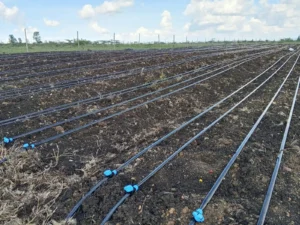
Unroll the 16mm drip tape down the length of each bed.
-
Crucial Rule: Always ensure the emitters face UPWARD so fine soil particles do not settle in and block the water outlets.
-
Push the start of the drip tape firmly onto the off-take valve barb and tighten the lock ring.
Step 5: System Flushing & Sealing
-
Before sealing line ends, open the main tank valve and turn on all off-take levers.
-
Allow water to run freely through the drip tape for 3–5 minutes to clear out dirt, soil particles, or plastic shavings.
-
Fold the tail end of each drip tape line twice and slide on a Figure-8 end closure to seal it.
5. Maintenance Tips for Longevity
-
Weekly Filter Cleaning: Unscrew the filter casing and rinse accumulated silt or organic debris off the disc/screen element under running water.
-
Monthly Line Flushing: Open the Figure-8 end closures once a month while water runs to purge trapped sediment from the ends of the lines.
-
Fertigation Best Practice: Always run clean water through the lines for 15 minutes after applying liquid fertilizer to prevent chemical crystallization inside the dripper channels.
Real Results: Local Farmer Success in Nakuru County
Case Study: Tomato Farming in Njoro, Nakuru
The Problem: Heavy leaf wetness from traditional bucket watering led to continuous early blight outbreaks, high chemical costs, and stunted yields.
The Solution: The farmer installed a 2-line-per-bed gravity drip system complete with a 1.5″ disc filter and Venturi fertigation kit.
The Result: Crop mortality dropped dramatically, chemical spray expenses decreased by 40%, and water usage was cut in half—allowing three harvest cycles per year.
Partner with Valuable Agrisystems
Ready to transform your farm with a reliable, climate-smart irrigation setup? Valuable Agrisystems supplies certified irrigation kits, HDPE dam liners, shade nets, and pumps, alongside complete professional installation services across Kenya.
What We Offer:
-
Custom Site Assessments & BOQs: Elevation profiling, crop-spacing designs, and tailored bills of quantities.
-
Quality Hardware Supply: UV-treated drip tape (15cm – 30cm spacing), disc filters, compression fittings, and booster pumps.
-
Turnkey On-Site Installation: Full field setup by certified technical technicians.
Contact Our Team:
-
Showroom Location: Savannah Business Centre, 2nd Floor (Opposite Rift Valley Sports Club), Nakuru, Kenya.
-
Phone / WhatsApp: +254 701 997 701